
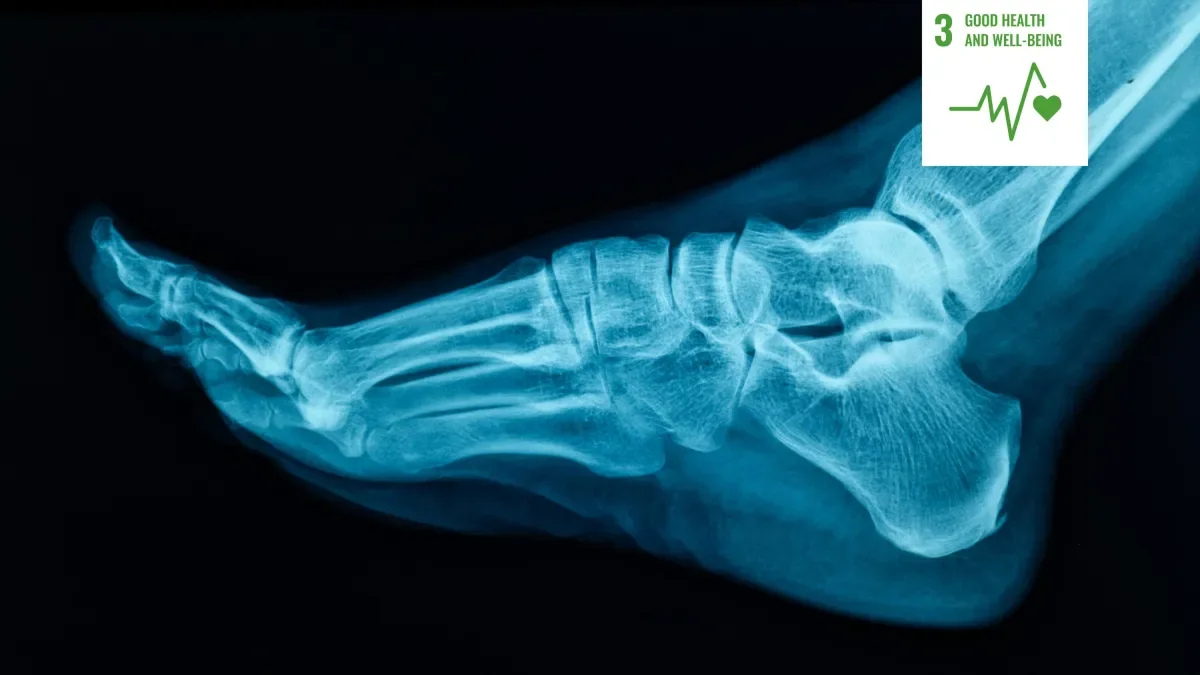
Complex bone fractures present significant challenges in healthcare, often requiring complex surgical intervention and leading to poor clinical outcomes. The Global Burden of Diseases report in 2019 highlighted a substantial increase of approximately 70 % in new bone fracture cases since 1990, with 145 million new cases reported.
Currently, metal hardware is widely used in treating post-traumatic bone injuries. However, this hardware has limitations and can result in poor healing and a lack of mechanical integrity, particularly in fractures occurring in patients with osteoporosis. Bone plates, screws and pins tend to loosen over time, necessitating their removal, which can lead to loss of crucial bone material. Additionally, there is currently no convenient method to stabilise small bone fragments and prevent micromotion in cases involving multiple bone fragments resulting from multiple breaks.
The icon on this article represents contribution towards the UN Sustainable Development Goals. The Sustainable Development Goals are 17 objectives designed by the United Nations to serve as a shared blueprint for peace and prosperity for people and the planet.
Current treatments
Calcium phosphate cement presents an alternative to metal hardware, but it still has inferior physical and biological properties compared to native tissue. This inferiority is due to its brittle nature and poor tensile and shear properties resulting from randomly organised networks of entangled crystals. The lack of effective commercially available bone bioadhesives is due in part to the complex nature of bone repair, a process which requires mechanical stability in wet conditions, sufficient working time for the surgeon.
OsStic® is an injectable bioadhesive that can be used to treat bone fractures. It is the result of a longstanding research collaboration between Biodesign Europe at Dublin City University and Irish MedTech company PBC Biomed. The recent ‘Breakthrough Device’ designation means the treatment has been ‘recognised as a superior device to medical solutions currently available on the market.’
Biomaterials and bioengineering
The new bioadhesive is a biomaterial, something which has been engineered to interact with biological systems, in this case to heal bone fractures. The bioadhesive uses phosphoserine, a common molecule found in numerous proteins which, when combined with alpha-tricalcium phosphate powder, generates adhesive biomaterial that can stabilise and repair bone fractures.
The underlying research behind this new bioadhesive was recently published in Acta Biomaterialia. The team used specialist data analysis software to investigate the capabilities of the bioadhesive, hitting upon an optimal formulation in terms of key clinical properties that can be manufactured at scale and is cost-effective.
Biodesign Europe at DCU
The Biodesign Europe research centre at DCU has been collaborating with PBC Biomed for the last eight years. This research project was made possible by €5.4 million in funding from the Disruptive Technologies fund which the two organisations secured as part of a consortium in 2021. Further funding came from the SFI I-Form research centre. PBC Biomed also has a three year ongoing relationship with DCU Invent, the university’s commercialisation unit. Biomimetic Innovations Ltd, an affiliate of PBC Biomed, made this latest announcement on the 26th January.
Biodesign Europe combines the research strengths of Dublin City University and Arizona State University to find new innovations in bioengineering and biomaterials. Their scientific discoveries and biomaterial innovations are being directed towards the areas of human health, community safety and global sustainability. Further information available here.
Biomimetic Innovations Ltd., is an affiliate of PBC Biomed; a medical device company involved in design, development and manufacturing headquartered in Shannon, Ireland and with offices in Memphis, Tennessee and Chamonix, France.