

Recruitment Toolkit 1: Pre-Advertising and Planning
This section aims to provide Hiring Managers with an overview of the main steps involved in the advertising and shortlisting stage of recruitment and selection process.
Overview of Process
Overview of Process
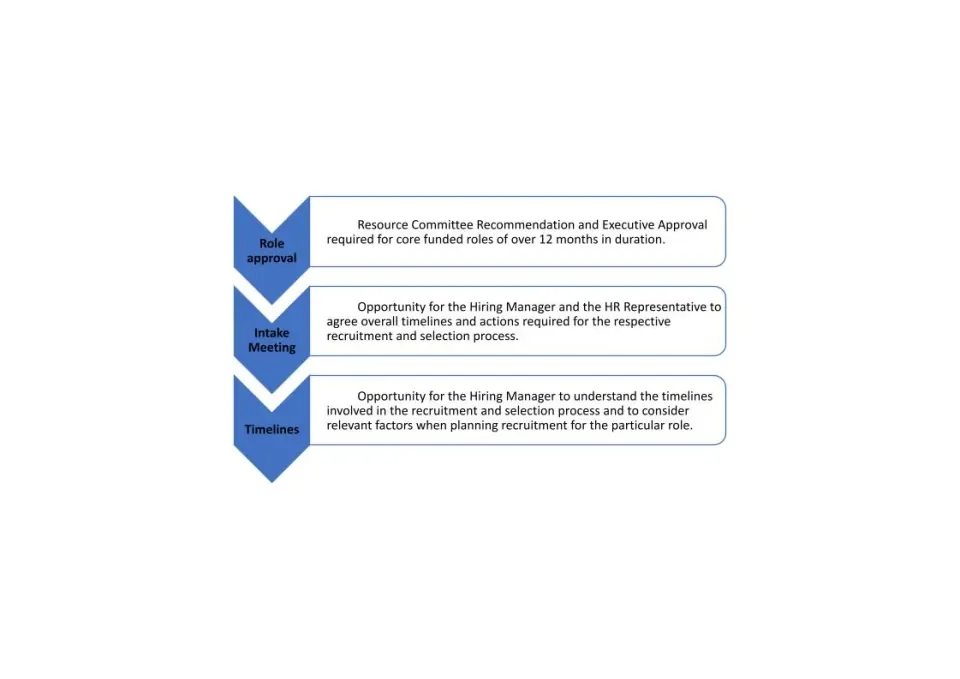
The following section outlines the approval process for core/Exchequer funded posts.
For information on research funded posts please refer to
Toolkit 3 - Interview Preparation & Process
Core/Exchequer funded posts of over 12 months in duration must be sanctioned by the Executive of the University. The University Executive, on the recommendation of the Resource Committee, sanctions posts. In all cases, budgetary and headcount considerations are taken into account. Heads of Schools/Units are required to justify the need for a post. Guidelines for Heads on how to submit an application for a post to Resource Committee together with the appropriate form (and associated job description) are outlined in the links below:
Once the core funded post has been formally approved by the University Executive, the hiring manager will need to contact the relevant HR Representative to arrange a recruitment agreement meeting.
The purpose of the meeting is to agree on all details of the recruitment & selection process for the relevant post. During the meeting the following points will normally be discussed:
- Job description and advert details
- Date and period of advertisement and potential advertising mediums
- Timelines for each stage of the recruitment and selection process e.g. advertisement, shortlisting, inviting candidates etc.
- Interview board members and completion of appropriate (Interview and Unconscious Bias) training for board members
- Potential dates of both preliminary (if required) and final interview (this is subject to confirmation and approval of the interview board)
- Any specific requirements e.g. teaching assessment or candidate presentation
- Any other details pertinent to the recruitment and selection of the role
All of the above details will then be recorded in the Recruitment Agreement/In-Take Form which will be signed off by both parties.
|
Activity |
Working Day |
Owner |
Recruitment Stage |
Checkpoints |
Timeline |
|
Resource Committee approved role notified to Hiring Manager (HM) and DCU People |
Start |
Senior Mngt |
Pre advertising |
||
|
PBP / HM Intake Meeting - following RC recommendation- Provisional Interview Dates Provided |
1 to 2 |
DCU People Business Partner |
Pre advertising |
PBP to contact HM to organise Intake meeting |
2 working days |
|
Job description prep, external board member sourced |
2 to 5 |
Hiring Manager |
Pre advertising |
||
|
University Executive approves role and HM and DCU People notified |
6 |
Senior Mngt |
Pre advertising |
||
|
Professional, Technical and Support Role Advertising Period (14 calendar days) |
6-16 |
PBP / Support Team |
Advertising |
Important to consider an extra 5 days for Academic or Senior roles |
|
|
Applicant data shared with HM |
17 |
Support Team |
Advertising |
Advertising period and shortlist shared with HM |
12 working days |
|
Shortlisting conducted by HM |
17-20 |
Hiring Manager |
Shortlisting |
||
|
Shortlist provided to HR |
20 |
Hiring Manager |
Shortlisting |
Shortlisting conducted and returned to DCU People Department |
4 working days |
|
Shortlist candidates invited to interview (7 working days in advance of interview) & unsuccessful candidates notified |
21 |
Support Team |
Interview organisation |
||
|
Interview books to be issued to the board |
25 |
Support Team |
Interview organisation |
Interview books issued to board |
3 working days in advance of interviews |
|
Interview conducted |
28 |
PBP / HM |
Interview stage |
||
|
Appointment approval from President sought and received |
29-30 |
Senior Mngt |
Post interview |
||
|
Offer made |
30 |
HRBP |
Post interview |
Hiring Managers need to consider several factors when considering time to hire. The DCU People Department will measure time to hire from the date of advertisement to the date of the offer of employment. However, this does not take into account the notice period required for the prospective candidate, which may vary and can take up to three months for academic or senior roles. The main factors the Hiring Manager needs to consider are as follows:
- When the Resource Committee will meet to recommend approval of a role;
- The terms and conditions of the role and anticipated level of interest in the role;
- Market forces and how accessible is talent at a particular point in time;
- Advertising period of between 2 to 4+ weeks depending on the role;
- Shortlisting process and anticipated number of applications;
- Time of year and interview board availability i.e. Summer availability can be problematic;
- January to June is peak time for academic recruitment and therefore there will be a high; demand for interview dates due to availability of panel members or logistics of interview set up;
- Whether preliminary interviews are required or would be beneficial;
- Adequate notice of interview date to candidates – at least one week depending on the level; and nature of the role, if candidates need to travel from abroad for interview;
- Whether Governing Authority approval is required before the role can be offered to the appointable candidate;
- If Governing Authority approval is required, when is the Governing Authority meeting scheduled;
- Notice period for successful candidates can vary from 4 to 12 weeks.
The HR department has set out timeline guidance but it’s important to note these are estimates and the above factors can either reduce or lengthen the Time to Hire.
- Professional, Technical and Support roles: 30 working days Time to Offer
- Academic roles: Can be longer than 30 days depending on advertising period
The job description sets out the overall context and the purpose of the job, the key duties and responsibilities, the reporting relationship and the environment within which the job operates. The job description is a key tool for attracting a diverse pool of applicants, as well as setting well-defined requirements to ensure consistent short-listing decisions.
It is important that all job descriptions are reviewed when a post becomes vacant and before any recruitment and selection procedures occur as elements of the role, its context, and structure will often evolve or change between appointments. All job descriptions should be sent to the relevant DCU People Representative for review in conjunction with the Resource Committee submission. Before a role is advertised, all job descriptions will be analysed by HR to ensure the job description is appropriate and accurately reflects the nature of the role and is attractive in a competitive job market. All role documentation will be processed through a decoder to ensure gender neutral language is used.
Job Description layout:
- Overview of DCU
- Overview of Department/Unit
- Role Profile
- Duties and Responsibilities
- Qualifications and Experience
- Essential Training
Overview
Job Title
Job title, Area of University/Department and Grade of role and contract type and length
DCU Overview
This will be a brief overview of the University that is set so no change in this section is required.
Overview of School/Unit
This section should provide details on the School or Unit wherein the role is based, what is the overall goal of the department, key areas of the department and structure of area. It is important that the wording of this section is attractive for candidates.
Overview of Role
This should provide the purpose of the role and reporting line. It should also outline any stakeholders with whom the role will engage. This section should be factual. It should also include any key points of delivery for the role, i.e. main projects or upcoming strategies within the department.
Tasks, Responsibilities
This is the most important section of the job description to outline the expectations of the role
- Outline main duties and responsibilities: highlight day-to-day activities, this allows candidates to understand the work involved and align if they have the experience required;
- Outline systems and software used within the role;
- The list should be in order of importance, be clear and avoid repetition.
Qualifications and Experience and Competencies
This section outlines the knowledge, skills, experience and competencies that are required for the role. This section should be created with the DCU Career/Competency framework in mind and be relevant to the job grade.
- Keep this list concise and relevant to the role;
- Years experience and level of education should be relevant for the role and in line with the incremental credit policy;
- Outline the essential systems knowledge required for the role eg. Oracle, CORE HR, SAP etc
- All qualifications and experience should be measurable and used for shortlisting
Essential Training
This area should cover any essential training that is required for the role
For example: The postholder will be required to undertake the following essential compliance training: The postholder will be required to undertake the following essential compliance training: Orientation, Health & Safety, Data Protection (GDPR) and all Cyber Security Awareness Training.