

Recruitment Toolkit 3: Interview Preparation & Process
This section aims to provide Hiring Managers with an overview of the main actions and considerations involved in organising and conducting interviews.
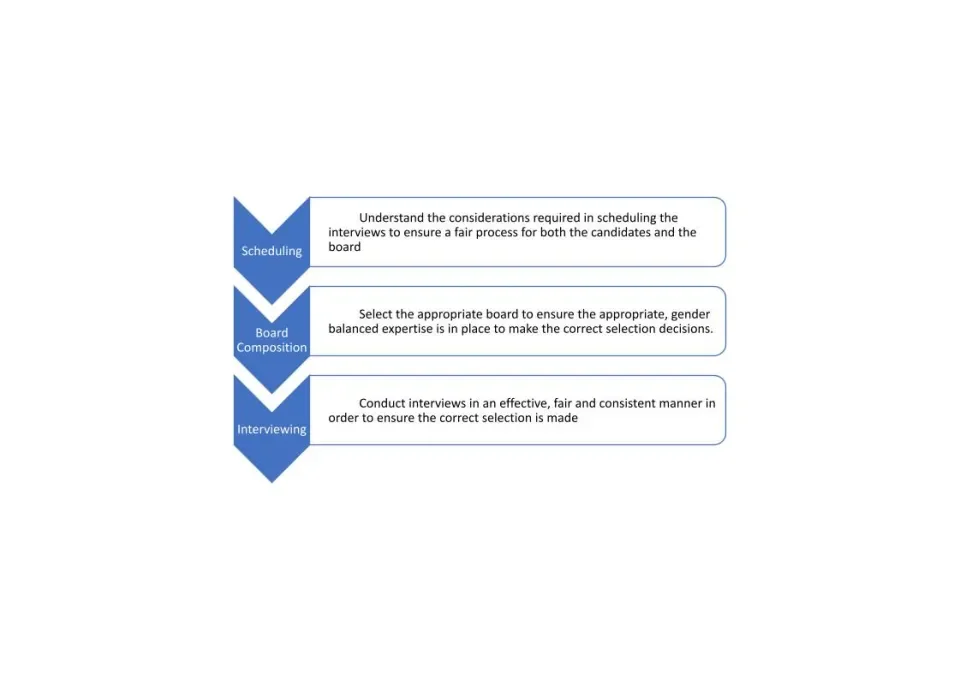
Overview of Process
Overview of Process
Preliminary interviews can be conducted for any role. They are not mandatory, with the decision to conduct preliminary interviews usually taken after the shortlisting is conducted, although it could be done at the outset. The decision should be taken in conjunction with the Hiring Manager and DCU People.
There are two main reasons for a Hiring Manager to consider using preliminary interviews.
- Reduces the number of candidates for a full board interview
- Allows the Hiring Manager two opportunities to assess candidates
- It is an extension of the shortlisting process particularly for roles which attract a high volume of candidates.
- Opportunity to delve into the technical expertise and for the candidate to provide more information in order to shortlist candidates to the full interview.
- Opportunity to validate the information provided in the application
- Biography and Technical skills/relevant experience for role;
- Role context and any questions raised by the candidate in relation to the role.
- Approximately 30 minutes, but it depends on the level of the role.
- It is recommended that there are at least two board members;
- Gender balance is strongly recommended.
- Preliminary interviews can be conducted via Zoom;
- Like any other interview the board should be fair and consistent with all candidates;
- Notes should be taken to provide feedback and evidence for selection/de-selection of candidates;
- Appropriate notice should also be given - at least 3 working days.
- The organisation of preliminary interviews will normally be done locally i.e. the Hiring Manager in their area;
- DCU People Department will provide a correspondence template that can be issued from the Hiring Manager to candidates;
- DCU People Department will issue follow up correspondence following the outcomes;
- DCU People Department can sit on preliminary interviews if requested and will normally do so for senior level (P8/Professor or above roles)
- DCU People Department will support preliminary interviews for senior level roles of Professor/P8 or above. Exceptions can also be made where appropriate.
The University aims to adhere to the underlying principle of conducting the majority of interviews in person.
External board members will ideally attend in person but can attend via Zoom on a case by case basis.
The majority of interviews will be conducted in the interview boardrooms in the DCU People Department on the Glasnevin campus and St. Patrick’s campus. This is to ensure that the appropriate facilities are provided and that both the candidate and board experience is satisfactory and consistent. From time-to-time interviews may be conducted in other venues subject to DCU People Department approval.
This section outlines guidance on conducting remote interviews.
Remote interviews are normally only used to interview external candidates based abroad. It should not normally be used for external candidates based in Ireland unless in exceptional circumstances.
A remote interview will normally only be facilitated if a successful test call has been conducted by the DCU People Department with the candidate in advance of the interview date. The test call should take place during normal business hours (Irish time).
If the interview is not conducted in person, then a second interview will need to be convened in person in order to recommend an appointment.
For relevant academic roles - an in person teaching presentation may be required with a reconvened interview board.
Interviews can be conducted remotely (i.e. usually via Zoom) and recommendations for appointment can be progressed, for the following roles:
- Research roles – Senior Research Fellow, Research Fellow, Postdoctoral Researcher and Research Assistant,Research Fellowship appointments
- Single non-competitive interviews
- Roles of less than 12 months in duration
- Heads of School and/or Associate Dean – subject to Executive Dean approval
- Single interviews for internal candidates
In order to protect the interview process and ensure fairness to both the candidates and interview board members, the following maximum candidate limits are recommended in most circumstances:
- A maximum of six candidates for in person interviews on any given day
- A maximum of four candidates, or four hours in duration for Zoom interviews
The DCU People Business Partner will agree the interview schedule with the Hiring Manager. The schedule will be arranged to ensure adequate attention is given to each candidate. Every effort should be made to adhere to the overall timetable to avoid candidates waiting for a period of time.
All candidates will be advised by the DCU People Department of interview times and any other arrangements, bearing in mind the need for adequate notice to prepare for the interview and for any other requirements such as presentations.
The following table outlines a guideline for interview durations depending on roles. As it is a guideline it can vary in certain circumstances but should give you an idea for scheduling.
|
Grade |
Duration |
|
Professor, Full Professor, Director |
1hr 15 minutes |
|
Associate Professor Assistant Professor Head of School/Unit Associate Dean Professional roles P7-9 |
1 hour |
|
Other roles |
45-50 minutes |
|
Local level interviews |
30-45 minutes |
|
Preliminary interviews |
20-30 minutes |
A formally constituted Selection Board must be convened for all advertised positions in excess of one year duration.
Key Principles for board composition
A selection board is constituted on the basis of a board member having the appropriate expertise to determine whether a candidate is suitable for appointment. With that in mind the following key principles will normally apply:
- Board members selected are experts in the relevant field;
- Boards will typically be composed of at least four persons (although can be in excess of this): two internal experts; one external expert and a DCU People Department representative;
- A HR representative will sit on all boards for all roles of 12 months or more in duration;
- An external expert will sit on all boards for all roles of 12 months or more in duration;
- Gender balance should as much as possible be achieved.
Board Approval
The composition of a proposed interview board will need to be approved by the relevant DCU People Department Representative before the interview can proceed. Approval will be based on adherence to the above principles and any other relevant factors. While there may be occasions for flexibility to be applied, it will only be on an exceptional basis.
Board Composition
The following is a summary of required interview board compositions for the various types of university roles. It is designed as a guideline and is not an exhaustive list. If in doubt you should consult with your DCU People Department Representative if you have a query regarding the composition of a particular interview board. Please also note that the gender balance requirement very much still applies.
|
Competitions |
Selection Boards |
|
Full Professor – Open Competition |
|
|
Full Professor (Internal Promotion) |
Process outlined in Promotion Scheme from (a) Associate Professor to Professor and (b) Professor to Full Professor. |
|
Professor – Open Competition |
|
|
Professor – Internal Promotion |
Process outlined in Promotion Scheme from (a) Associate Professor to Professor and (b) Professor to Full Professor. |
|
Associate Professor – Open Competition |
|
|
Associate Professor – Internal Promotion |
Process outlined in Promotion Scheme from (a) Associate Professor to Professor and (b) Professor to Full Professor. |
|
Associate Professor – Targeted promotion (Senior -Junior Ratio) |
|
|
Associate Professor – Targeted Promotion – Other scenarios |
|
|
Assistant Professor – Above or below the bar Open Competition |
|
|
Progression or Accelerated Progression to Assistant Professor (Above Bar) |
|
|
Associate Dean (Teaching & Learning, Research or International) |
|
|
Head of School |
|
|
Head of Unit |
|
|
Other Roles – Admin, Management, Library, Research, Technical |
|
Conflict of Interest
It is essential that the recruitment and selection process is open, transparent and fair. In situations where a member of the Interview Board has a potential conflict of interest because of a personal or other relationship with a candidate or candidates, this conflict must be made known to the Chair and to the other Board members as well as DCU People Department in advance of the interview. In particular circumstances, the Board may decide that the involvement of the individual might undermine the fair and balanced application of the relevant procedures.
All staff members involved in the recruitment and selection process are required to complete the Recruitment Skills – Interviewing and Unconscious Bias online training. This training ensures Selection Board members will have an understanding of:
- DCU Recruitment and Selection process;
- Preparing a job vacancy advertisement and identifying selection criteria;
- Potentially damaging impact of Unconscious Bias during the selection process;
- How to prepare for and conduct a quality interview;
- Using effective questioning techniques;
- Making evidence-based decisions;
-
Information on Equality and Freedom of Information legislation relevant to the selection process.
References provide useful additional information concerning candidates and can significantly aid recruitment recommendations and decisions. Referees should always be persons with current knowledge of the candidate, are contacted and provided with copies of the advertisement and the job description and are asked to provide their opinion of the candidate’s suitability for the post. HR will circulate the references to all members of the Selection Board, if received in advance of the interview date.
Procedures for References
Written references will be sought prior to the final interview for all candidates for all academic grades positions and professional grades of Professional 6 or higher subject to candidates permission.
Candidates for positions will only be formally offered a position on receipt of three written references (including one from the current employer) to the DCU People Department which are deemed satisfactory to the University.
References will be shared on the drive accompanying the interview book.
As part of the interview and assessment process for academic posts, candidates being assessed for Assistant Professor and Associate Professor posts will be required to make a teaching presentation to the assessment board. The teaching presentation will be delivered prior to the commencement of the interview and is designed to assess candidates teaching, presentation and communication skills.
Candidates must achieve a satisfactory grading in this assessment to be considered eligible for appointment.
- Each candidate will be advised at the formal invite stage that they will be required to make a presentation;
- The topic will be decided by the hiring manager and should be clear and concise as to ensure it will not be misinterpreted by candidates;
- Candidates will be given adequate time to prepare a presentation in advance of the interview;
- The presentation will typically be 10 minutes in duration;
- Candidates will be required to forward their teaching presentation to DCU People Department ahead of their assessment;
- The same interview board will assess both the presentation and interview.
Ideally candidates will deliver their teaching assessment in person. If the candidate is being interviewed remotely (i.e. via Zoom) they may deliver a teaching presentation online. In this instance, as outlined above, a second interview will need to be convened in person to confirm the appointment.
Candidates for Professor/Full Professor or Professional/Technical posts may also be required to deliver a presentation, the nature of which will be determined for the particular post.
Prior to the interview, the DCU People Department shall prepare and share an interview book online with each member of the Selection Board which will include the following:
- A copy of the advertisement, job description and the selection criteria for the post;
- A schedule of all candidates called for interview;
- A copy of the application material submitted by the candidates to be interviewed, together with referees' reports if received;
- An Interview Assessment Form for each candidate;
- A Staff Selection Form for signature by the Selection Board members.
The DCU People Department should ensure that adequate physical and online facilities are made available so as to aid the interview process, and also to generate a good "first impression" of the University. The physical facilities should include an appropriate interview room and a private waiting room.
The below outlines how an interview should be structured to provide a positive candidate experience.
Introduction
- DCU People will collect the candidate from the waiting room;
- The Interview Chair will thank the candidate for their time, introduce each board member including name and title;
- Interview chair will provide an overview of the interview structure including when they can ask questions to the panel and how long the interview is expected to last.
Presentation/Teaching assessment (If applicable)
- Allow time for candidates to issue any handouts as part of their teaching assessment;
- Advise that assessment/presentation will be timed, and they will be notified when their time is up.
Interview Questions
- Each board member will have an opportunity to ask questions on their designated area as discussed in advance of the interview;
- Important to keep questions clear and relevant;
- Ensure not to interrupt the candidate when answering questions.
Q&A
- This gives the candidate time to ask any questions or add any point they feel they did not get an opportunity to make;
- This is an important element of the interview as this is the candidates assessment of DCU and the School/Unit;
- Ensure answers are managing their expectations.
Wrap Up
- Thank the candidate for attending;
- Provide details on the timeline and next steps.
Types of Interview Questions
It’s important to be aware of the types of interview questions and how they assess candidates.
Care should be taken to ensure that any questions asked cannot be construed as potentially discriminatory under the nine factors covered by the Employment Equality Act, 1998 – 2015.
Situational Questions
These are based on specific scenarios that will be connected to the role.
Example of situational style question:
- Tell me about a time you went above and beyond on your job duties.
- Tell me about a time you had to make an unpopular decision
Competency based questions
These questions are used to assess specific attributes, knowledge and behaviours. These questions should be aligned with the DCU People competency framework.
Example of competency based questions
- Communication style: Describe a situation where you had to explain something complex to a colleague or a client. What problems did you encounter and how did you deal with them?
- Collaborating and partnering style: Describe a time when you faced resistance or negativity and how you responded to this?
Behavioural questions
These questions allow the board members to understand future behaviours based on past reactions or experience.
Example of behavioural style questions
- Have you ever made a mistake? How did you handle it?
- Give an example of how you set goals.
Interview Questions to Avoid
Closed ended questions
These questions usually lead to a short yes/no answer.
Example:
- Do you have teaching experience?
Leading questions
These questions imply what the answer should be or give a suggestive answer.
Example:
- Do you agree that DCU is the top University in Ireland?
The role of the Chairperson of the Interview Board (normally the Executive Dean/Head of School/Unit) is crucial as it is their responsibility to coordinate the interview and to ensure that it is conducted fairly and without discrimination or bias. This normally includes the following actions:
- Chair the briefing discussion prior to interviews, deciding on what topics should be covered by each board member;
- Introduce the Interview Board members to the candidate and explain the format of the interview process;
- Provide a comfortable setting for candidates e.g. ensuring there is water for the candidate, rephrasing questions if necessary etc;
- Ensure that each candidate feels sufficiently at ease to be able to communicate effectively during the course of the interview;
- Ensure that the Interview Board has gathered sufficient information and evidence on each candidate to enable a valid assessment to be made regarding the candidate's suitability for the post;
- Conclude the interview and informing each candidate of the next stage of the process;
- Coordinating the Selection Board in the assessment of the interviewed candidates and seeking agreement from the Board on the rank order of the candidates who are deemed suitable for appointment to the position;
- Identify if one or more candidates are appointable and if so in what ranking order;
- In conjunction with the DCU People Representative ensure that the decision of the board and rationale are clearly recorded in the relevant sections of the interview book – please see Documenting the Selection Decision below.
The role of the interview board is to assess all candidates in line with the role criteria to determine if one or more candidate(s) are deemed appointable. If so, a recommendation is made to the President for the appointment(s). The interview board is not in any way involved in discussions regarding potential details of an offer of employment.
The key actions of an interview board member are summarised as follows:
- Ensure that they have undertaken interview training including unconscious bias and that they treat each candidate fairly and consistently e.g. remove any laptops and phones from the boardroom table;
- Participate in the briefing discussion prior to interview;
- Give prior consideration to the areas to be addressed, to ensure their purpose and clarity and ensure that all interviewees will be similarly assessed;
- Ensure that they are familiar with the full details of all candidates applications;
- Ask appropriate questions (which may be agreed in advance with the Chair) to ensure that you can make an accurate assessment of the candidate’s suitability for the role, based on the criteria outlined in the job description and associated documentation;
- Attentively listen to all answers delivered by the candidate and document key points of note;
- Articulate their assessment of each candidate against the agreed selection criteria, providing evidence to back up their assessment;
- Identify if one or more candidates are appointable and if so in what ranking order;
- In conjunction with the DCU People Representative ensure that the decision of the board and rationale are clearly recorded in the relevant sections of the interview book – please see Documenting the Selection Decision below.
- The interview book is designed to provide the required information to the interview board and also to ensure that there is a single source of information on the selection decision.
- The assessment and ranking of the candidates must be based on all aspects of the selection process. This includes written application, interview, presentation (if relevant) or any other testing, together with referees' reports, completing the Staff Selection Board Report Form which is included in the Chairperson's interview book.
- Any supporting evidence must be clearly and comprehensively documented. The completed Staff Selection Board Report form should list the names, in rank order, of those candidates deemed suitable for appointment to the post. The Chairperson's report should also contain statements on all interviewed candidates (normally referring explicitly to the strong and weak points of each interviewed candidate as agreed by the members of the Selection Board). All members of the Selection Board should sign the Staff Selection Board Report Form.
- The Chair will complete the Interview Assessment Form for each candidate. The form will represent a collation of feedback from all board members. The form will be uploaded to the shared drive along with any other relevant documentation including notes taken during interviews. Interview Selection Board members may also complete their own form should they wish to do so. All board members should be aware that any notes that they take are discoverable under Freedom of Information legislation.
It’s important that notes are taken throughout an interview to document any details.
Guidelines on note taking:
- Notes should be factual and have no reference to any personal details or details relating to the 9 protected characteristics under the Employment Equality Act 1998-2015;
- Notes are useful for deliberations when referring to how a candidate answered questions throughout the interview;
- Any notes taken during the interview should be given to HR at the end of deliberations;
- Notes can be requested by candidates under Freedom of Information and GDPR legislation.
Confirmation of Appointment Process for Research Fellowships
The University asserts that a transparent merit-based assessment is conducted for all candidates. As a result, we normally stipulate that vacancies of over 12 months in duration are filled through open competition. However, in certain situations, where deemed appropriate, the University provides flexibility in the form of assessment applied and may conduct a single confirmation of appointment process. This process allows for a single candidate to be assessed for a post through a confirmation of appointment process.
Research Fellowships occur where a single confirmation of the appointment process is deemed appropriate is in the case of a Research Fellowship. In this instance, as the candidate under consideration is inextricably linked to the funding of a research award.
A research fellowship grant refers to an amount paid or allowed to, or for the benefit of, a specific individual to aid him/her in the pursuit of study or research. In this instance, the award is linked to the named individual alone and not to the institution.
The Confirmation of Appointment Process for Research Fellowships policy outlines the necessary procedures involved in the recruitment for Fellowship roles.