

Recruitment Toolkit 2: Advertising and Shortlisting
This section aims to provide Hiring Managers with an overview of the main steps involved in the advertising and shortlisting stage of recruitment and selection process.
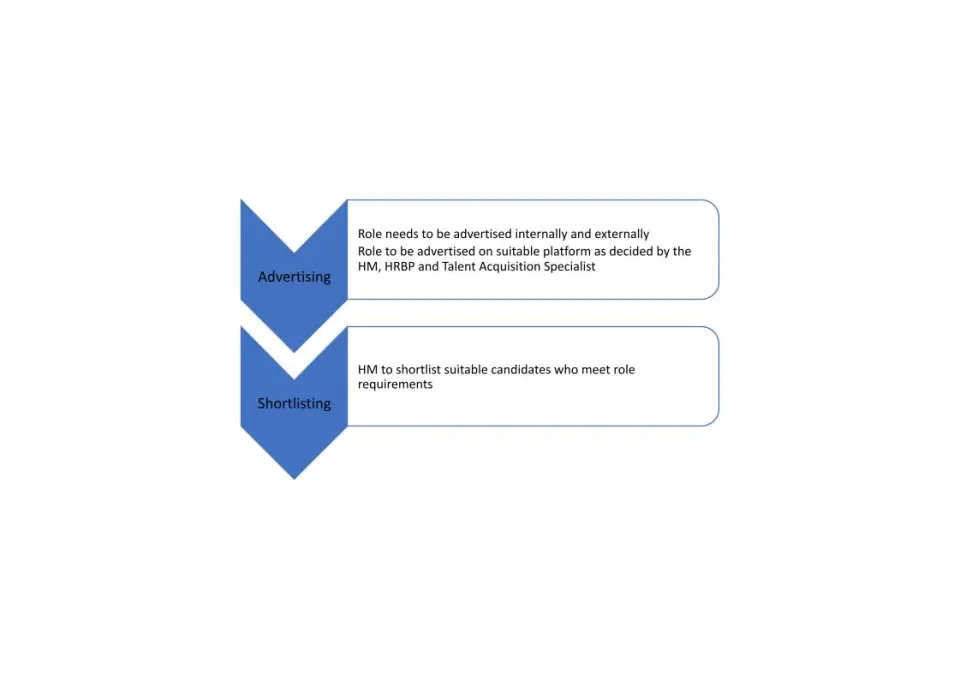
Overview of Process
Overview of Process
Dublin City University is an equal opportunities employer. In line with the Employment Equality Acts 1998 – 2015, the University is committed to equality of treatment for all those who engage with its recruitment, selection and appointment processes. Vacancies should be advertised to attract the best and most diverse field of applicants. All advertisements should include an equal opportunities statement.
The following guidelines apply to the advertising of roles in the University:
- All roles of over 12 months in duration will normally be advertised on the DCU vacancies website;
- Grades P3, P5, Assistant Librarian 1 and Chief Technical Officer will be advertised internally for one week initially;
- Internal service criteria will be applied to all professional grade roles advertised.
An email outlining all adverts posted on the DCU vacancies website is sent to all DCU employees every Friday.
Advertising Media
In addition to the DCU vacancies website the following advertising media options are available;
|
Media |
Grades |
Cost |
Automatic or Request |
Comment |
|
University Vacancies Ireland |
All |
Free |
Automatic |
Academic |
|
Euraxess |
Research |
Free |
Automatic |
Academic/Research |
|
Researchgate |
All |
€789 - 2 job slots for 30 days |
Request |
Academic/Research only |
|
|
All |
Free for the first 5 vacancies if a slot is available. €200 per role thereafter |
Request |
Professional/ Academic roles |
|
Irish Jobs |
All |
PBP will advise |
Request |
Ideally Professional roles up to P5 |
|
Indeed |
All |
PBP will advise |
Request |
Ideally Professional roles up to P5 |
|
jobs.ie |
All |
PBP will advise |
Request |
Ideally Professional/Technical |
In areas where recruitment is more specialist or complex or where the Hiring Manager wishes to reach a specific audience, additional advertising platforms may be used. The School or Unit must cover any additional costs and provide a PO in advance. Advertising should be cost-effective. The DCU People Business Partner can advise on the various options available.
All job advertisements are agreed upon between the DCU People Business Partner and the Hiring Manager.
Access to applications for a recruitment competition is restricted to members of the Selection Board, staff of the DCU People Department and any staff members from the School/Unit where the vacancy has arisen who have been nominated by the Head of School/Unit to participate in the shortlisting process.
The Head of School/Unit, staff of the DCU People Department and involved staff members shall ensure that all applications are treated confidentially.
The Head of School/Unit has responsibility for the screening of all applications received to produce a shortlist for interview. Other staff members from the school/unit at the appropriate level should be involved but this number should not exceed the number of people sitting on the interview panel i.e. 4 to 5 persons.
Prior to shortlisting, the Head of School/Unit should adhere to the selection criteria in line with the job description for every vacant position.
- Screening should be carried out as soon as possible after the closing date for receipt of applications;
- Those participating in the screening process will therefore receive a full set of applications, together with the selection criteria and job description that will be sent by the head of school/unit;
- Only those candidates who meet all the essential criteria should be shortlisted for interview
- Where appropriate, it may also be necessary to review the desirable criteria as outlined in the advertisement;
- Preliminary interviews may be used to assist in shortlisting when a large number of applications are received. Please see Toolkit 3 - Interview Preparation & Process
- Interviews will not be organised until shortlisting is completed;
- The DCU People department will provide written notification to all candidates who have not been shortlisted.
- Developing the advertisement and job description;
- Considering all applications, deciding on whether a further search for candidates is necessary;
- Carrying out detailed screening of all applications in a timely manner;
- Completing the Shortlisting Form ensuring that the reasons, related to the selection criteria, for each unsuccessful candidate are recorded;
- Ensuring the completed Shortlisting Form is shared with the relevant HR Business Partner on the shared drive allocated to the competition. This completed form will facilitate any subsequent feedback requests from candidates;
- Holding preliminary interviews and/or other selection activities as appropriate;
- Where internal candidates are not shortlisted, the Head of School/Unit will verbally notify the candidate after the screening process;
- Providing feedback in a timely manner to all unsuccessful candidates as required. Feedback should be constructive and focus on the candidate’s performance in relation to the selection criteria. It is not appropriate to discuss with the person seeking the feedback any other candidate's application.
Representations on behalf of an applicant, including unsolicited recommendations, will be treated as canvassing. Canvassing seeks to establish an unfair advantage for one applicant relative to others and may result in the disqualification of that applicant.