

Overview

During this two-year course, you’ll discover how to empower, motivate and engage children. You’ll also explore the latest approaches to helping them develop critical skills, including how to understand, analyse and apply what they learn. The course is designed to help students give every child the best education and to challenge traditional, often limiting, teaching approaches. Our large lecturing staff are experts in their field and are very keen to support and motivate you in your learning journey.
Get ready for a diverse learning experience
Modules are delivered through lectures, seminars, workshops and outdoor classes, while assessments include written assignments, interactive oral exams, quizzes and portfolios.
You’ll also undertake 24 weeks of placement in primary school classrooms in both mainstream and special education teaching settings. The first placement will be a staggered, supported placement where you will begin going out to the school two days a week, while attending lectures to allow you to discuss your evolving school experience with your lecturers. You will begin by observing and completing reflective tasks and gradually start planning and teaching lessons. This will culminate in a block of two-weeks of teaching.
Once you graduate, you can pursue a career as a primary school teacher or move into areas like educational administration, consulting, content writing, research or educational policy. Alternatively, you may choose to work in educational support services like the Professional Development Service for Teachers or the National Council for Curriculum and Assessment.




DCU People
Careers & Further Options

Careers
DCU Graduate teachers enjoy high employment success rates - 99% of DCU Institute of Education graduates are in employment or further education some six months after graduation.
While most of our graduates will work as teachers in primary schools, others will pursue further studies in education and related fields, such as guidance, pastoral care, school leadership and management.
Others graduates will work in Further Education, Higher Education, government departments and other education and training settings.
- Adult Education
- Education
- Government Departments
- Post Primary Education
Entry Requirements

ENTRY PROCESS FOR DC970
Note: The Department of Education Entry Requirements for a Professional Masters of Education (2025) is available in Irish here and in English here
Before making your application to DCU DC970:
Candidates wishing to apply for the Professional Masters of Education (Primary Teaching) MUST take Teastas Eorpach Gaeilge (TEG) Level B1 Oral Irish examination. A minimum of 65% must be attained on this examination to be eligible to apply for the PME (Primary) programme.
The TEG B1 Oral Irish examination dates for the Professional Masters of Education (Primary Teaching) 2025-26 are:
- 16th & 17th May, 23rd and 24th May 2025
- For entry to the PMEP application process for 2025-26, the closing date for applying for the TEG oral examination is 12pm, 23rd April 2025
- See www.teg.ie for more information.
- A successful result in the TEG B1 Oral Irish examination will be valid for two years before the examination needs to be retaken
- Applications for the TEG B1 Oral Irish examination are made directly through TEG.
Further information can be found on the TEG website:
Further details on the application process should be viewed at the Next Steps section
Programme Structure

With more than 4,000 students, the DCU Institute of Education is Ireland’s largest provider of education and training with over 150 academic staff with expertise in education. We take a modern, innovative and creative approach to education. However, the PMEP cohort itself is small in size, allowing you to thrive within a smaller group while also enjoying the full university experience.
The PMEP programme starts in September each year. AT the end of August, there will be an optional Dianchúrsa sa Ghaeilge (for those keen to improve their Irish) followed by an optional school observation experience in DCU’s Changemaker Schools Network (for those keen to see high quality practice in action prior to beginning lectures). Then, lectures begin in early September five days a week over two semesters. There will be some hybrid components of modules which will allow some learning to take place on-line but most of the learning will take place on campus. There will be two Gaeltacht courses during the programme (May in PMEP1 and Easter in PMEP2). This is a two-year full-time course.
Fees and Funding

How To Apply

To apply for this programme:
- All Applicants must apply through DCU's Student Application Portal which is available here. Here's a quick step by step guide if you need help with your application. Applications will reopen on Thursday 10th April 2025 and close on 6th June 2025.
Applications must include:
- Academic Transcripts of Results for UG honours degree, with overall results of H2.2 or higher, (if you are in your final year of your Undergraduate Degree please upload transcripts for each year of study to date)
- Evidence that you have fulfilled the minimum requirements for the following subjects:
- Gaeilge: Leaving Certificate transcript (or equivalent)
- English: Leaving Certificate transcript (or equivalent)
- Mathematics: Leaving Certificate transcript (or equivalent) - Irish language oral proficiency (65% on Teastas Eorpach na Gaeilge, TEG, B1)
- Passport Photograph
- PMEP Additional Questionnaire (submitted within the Online Portal).
Please view the following documents for further information:
- Application Information in full can be found at the DC970 Programme Guidance Notes
- How to calculate the scoring for assessment of applications on the programme -
DC970 PMEP Points Scoring System
- Our list of Frequently Asked Questions from Applicants can be found here
Important Notes
It is the responsibility of the applicant to ensure that each document submitted is valid evidence that the applicant achieved the required standard. Each document must be an official statement from a relevant institution, e.g. Certified university transcript (bearing stamp and signature), TEG certificate, school Leaving Certificate transcript (with candidate name, school name and year clearly shown). Screen shots, emails or portal page printouts will not be accepted, and your application will be declined. Please ensure to use a valid email address for the application, as updates will be provided via this address and check that spam filters are not in operation.
Please note that all PMEP students must undertake two mandatory Gaeltacht Placement periods as pert of the programme. The first mandatory placement will be at the end of first year in May 2026 for the incoming first year cohort.
Application Deadlines
Applications will be accepted until 6th June 2025. All documentation must be provided by this date (with the exception of final year transcripts and/or TEG Certificate).
Late applications will not be accepted. Applicants who have not yet completed their Undergraduate Degree, have until the 11th of July 2025 to submit their final transcripts and/or submit their TEG Certificate (screenshots or emails not accepted).
Queries
Queries on applications may be emailed to pgedapplications@dcu.ie. Please include the programme code (DC970) in the subject line of your email.
Commencement of Programme: August 2025
Life On Campus

At DCU, our students can expect a unique campus experience. We are known for our excellent teaching and learning facilities, our active clubs and societies, and our great social and sporting facilities. All this makes DCU an exciting place to be.
DCU has three academic campuses; Glasnevin, St. Patrick’s and All Hallows (both in Drumcondra), all close to Dublin City centre.
They can be reached by public transport, Dublin Bus and Bus Éireann, with our Drumcondra campuses a ten minute walk from Drumcondra Train Station. Glasnevin is a 20 minute walk from St Patrick’s and All Hallows. They are also linked by Dublin Bus.
Each campus has a library (O’Reilly, Cregan and Woodlock Hall), study spaces, restaurants, and on-campus residencies. There are sports facilities on Glasnevin and St. Patrick’s, and there is a dedicated sports campus, St Claire’s, located near Glasnevin on the Ballymun Road.
DCU’s 19,000 students have access to exceptional teaching and learning facilities across our three academic campuses.
These include modern learning theatres, research centres, a new media and TV studio, radio/podcast studios, computer suites and advanced labs in the areas of Languages, Engineering, Physics, Chemistry and Biotechnology, as well as a Sports Performance centre and a training hospital ward. In 2021, we opened our first virtual reality ‘Leadership Lab’, which is located in our Business School.
We continue to improve and update our facilities. For example, construction of a new world-class STEM facility is underway on the Glasnevin campus. With capacity for an extra 3,000 STEM students, this facility will advance DCU’s international reputation for excellence in science and health, computing and engineering disciplines.
Studying in DCU isn’t just about course work. The university is rich in student life and activities.
There are more than 140 clubs and societies for students in DCU, with ‘Clubs & Socs’ days taking place on both the Glasnevin and Drumcondra campuses at the start of the academic year. They span everything from rugby to rock climbing, anime to jazz.
For many students, sport is an important part of the DCU experience. DCU’s Sports Complex boasts a 25 metre swimming pool, fitness centre gym, all-weather pitches and squash courts, as well as soccer, GAA and rugby pitches. DCU Dóchas Éireann, the university’s GAA club, is the largest third level Gaelic Games club in the country. Meanwhile, DCU Athletics has been Ireland’s highest achieving university club for many years. And DCU has dozens of other clubs to get involved in, from Archery to Weightlifting.
The Glasnevin campus is home to our purpose built, state-of-the-art student centre, The U, which serves the needs of a rapidly growing student body. Here, you will find the Student Leadership and Lifeskills Centre, performing arts and cultural spaces for students and the wider community, and the Entrepreneurship and Innovation Hub. Also located on our Glasnevin campus is The Helix, our renowned performing arts centre.
On our St Patrick’s campus, we have the Java Student Hub, a vibrant, warm and welcoming space where students can meet for coffee, play music, use the projector to watch events, or just relax. The walls of the Java Hub were designed based on the cultural history of St Patrick’s Campus, including the special references to the notable sporting history and history of the arts.
We have a number of academic, professional and social supports for students.
Student Advice & Learning Skills Centre - Offers a wide range of supports and services to students and advice
The Writing Centre - drop-in writing workshops for students through the academic year
Maths Learning Centre - provides maths support for students of all ability levels with maths modules
Student Learning - facilitate the transition from passive to active learning for students at DCU, by teaching study skills, nurturing critical thinking and building student confidence.
Careers work with students to help them on their professional journey into graduate employment.
Our student support team offers a comprehensive support programme, helping students make that all important transition into university life and focusing on building confidence and skills which are key to success at third level.
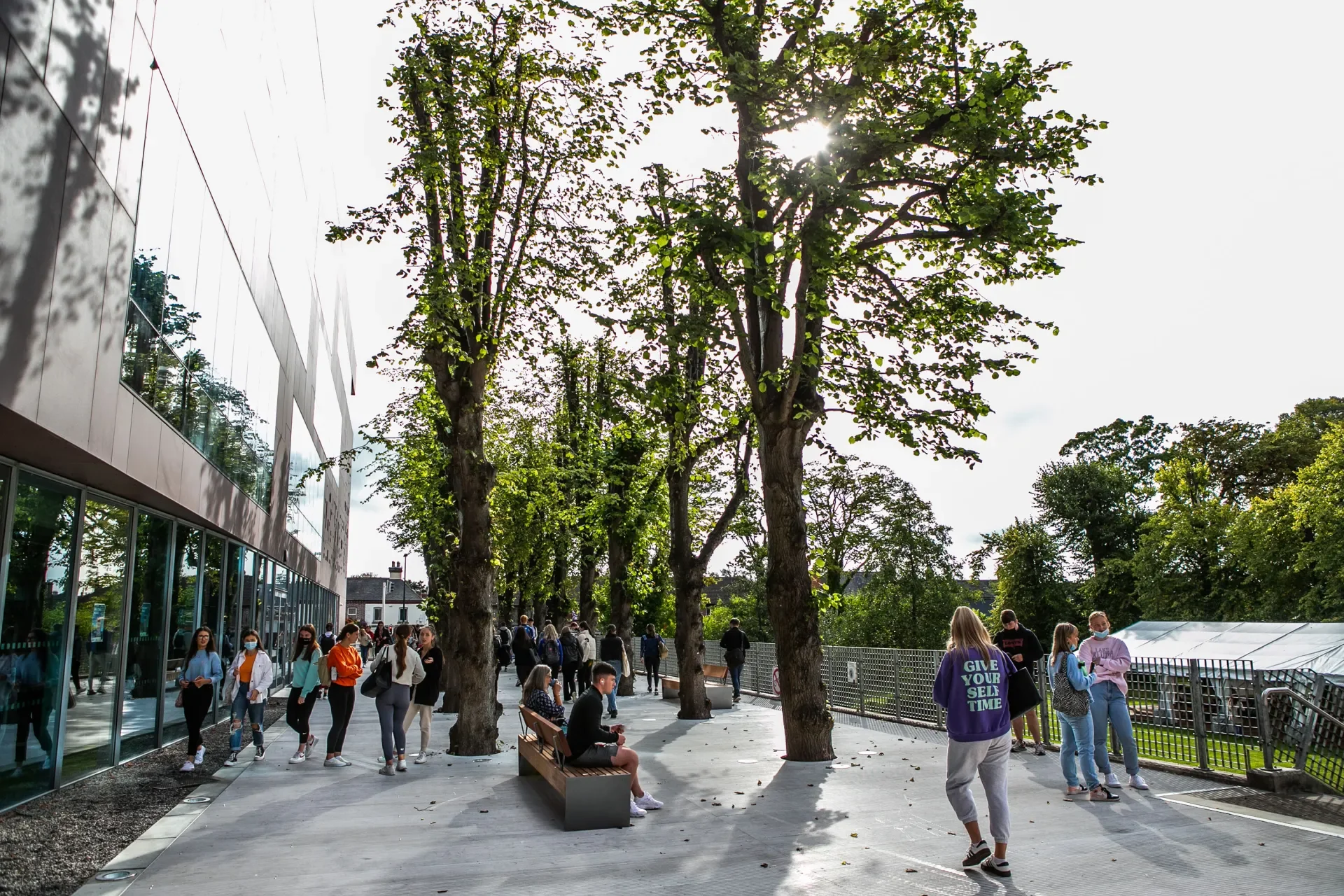
DCU St Patrick's Campus
FAQs

What courses are offered by the DCU Institute of Education?
DCU Institute of Education brings together students of education and provides a rich menu of undergraduate courses across all sectors from early childhood, to primary and post-primary and further and higher education. We offer a range of taught and research postgraduate courses at doctoral, masters, diploma and certificate level and have a distinguished record in providing continuing professional development.
Is there Garda vetting for students who study DCU Institute of Education courses?
Garda vetting is required for all students who have unsupervised access to children and vulnerable adults as part of their studies at DCU. Applicants must successfully pass the Garda vetting process in order to complete the registration process.
What are the potential teaching pathways for primary, post-primary and further education and training offered by DCU?
Primary Teaching Pathways
Undergraduate*
Postgraduate**
- Professional Master of Education (Primary Teaching) - DC970
* Please ensure that you consult minimum entry requirements and CAO points for all undergraduate programmes
** Please ensure that you consult minimum entry requirements for all postgraduate programmes
Post-Primary Teaching Pathways
Undergraduate*
- Bachelor of Religious Education & English or History or Music - DC010 | DC011 | DC012
- Bachelor of Education in Gaeilge and French or German or Spanish - DC013
- Bachelor of Education in Technology, Engineering and Graphics - DC015
- Bachelor of Science (Hons) in Science Education - DC203
- Bachelor of Science (Hons) in Physical Education with Biology - DC205
- Bachelor of Science in Physical Education with Mathematics - DC206
Postgraduate**
- Professional Master of Education (Post-Primary Teaching) - DC905
* Please ensure that you consult minimum entry requirements and CAO points for all undergraduate programmes
** Please ensure that you consult minimum entry requirements for all postgraduate programmes
Further Education and Training Teaching Pathways
Undergraduate*
- BSc (Hons) in Education and Training (Further, Adult and Continuing Education) - DC235
* Please ensure that you consult minimum entry requirements and CAO points for all undergraduate programmes