
Open Research - Open Access
Open Access
DCU Open Research

Open Access refers to the principle and practice of making digital versions of scholarly publications freely accessible. This has multiple benefits over paywalled material, such as greater reach and impact, public and equitable access to research, and broader influence for research beyond academic institutions, such as Influencing policy and practice.
Green OA with DORAS
Green Open Access refers to self-archiving a copy of your published work in an open access repository. Typically, this is the Author Accepted Manuscript or AAM as the author retains ownership of copyright for this version.
Doras [www.doras.dcu.ie] is DCU's Repository which curates, collects, preserves, and provides open access to DCU Research. We accept AAMs for journal articles in peer reviewed journals along with many other research outputs.
Any staff member can submit their work to Doras using their DCU login. Research theses are uploaded for research students by their supervisor(s).
Research Publications on DORAS
- Directly, at doras.dcu.ie (see demo video below)
- Email to doras@dcu.ie
- Via Research Engine (for staff)
No. We ensure that any material uploaded to Doras are fully compliant with copyright before they are made available. Sometimes this relates to the correct version being uploaded (usually the Author Accepted Manuscript is what we look for).
All DCU affiliated staff and postgraduate research students can put their published research in Doras. If you have co-authored a paper with colleagues from another institution, these items are also suitable for upload.
Generally speaking, Doras is intended for outputs of research undertaken while at DCU. If you are unsure, please contact doras@dcu.ie and we can check this for you.
Theses on DORAS
Step-by-step instructions on how to deposit a thesis to DORAS can be found here.
Please note:
- The supervisor/internal examiner of the thesis must deposit the e-thesis to DORAS on behalf of the candidate
- Only Research Masters and PhD theses submitted to Registry for the next conferring are accepted
- For full guidelines on theses please visit Postgraduate Research: Academic Regulations & Guidelines
On DORAS theses may be browsed by:
Most publishers do not consider your thesis a 'prior publication' and will not reject an article submission for this reason. Generally speaking, content from your thesis will require a good deal of reworking if being submitted to a journal or book publisher but the fact of it appearing in your thesis will not impede your chances of acceptance.
Here we have collated publisher policies on journal submissions based on research in already-released theses.
| Publisher | Policy on articles based on theses |
| ACS |
Policies set by individual journal |
| AIP |
Permitted |
| Cambridge UP |
Permitted "Publishing content in a thesis or dissertation is not considered prior publication, and is permitted under this policy" |
| Company of Biologists |
Permitted "For publicly available theses, the text ideally should be rewritten to ensure that the submitted paper is original. This will avoid potential issues regarding copyright if owned by a third party. Any data previously presented in a thesis in whole or in part should be detailed in the Acknowledgements section with complete citation details." |
| Elsevier |
Permitted |
| Emerald |
Permitted "Yes, you can [submit a paper based on my thesis]. Please submit your paper in the usual way but declare the existence of the uploaded thesis to the Editor of the journal." |
| IEEE |
Permitted "Allowed if the content has not been published in another journal. It should be mentioned as part of the acknowledgment section that the research was undertaken as part of a PhD." |
| IOP Publishing |
Permitted "Articles based on theses may be submitted. You should take care to ensure that such articles are prepared in the format of a research paper, which is more concise than is appropriate for a thesis"" |
| Microbiology Society |
Policies set by individual journal |
| Nature Research |
Permitted "Nature Portfolio will consider submissions containing material that has previously formed part of a PhD or other academic thesis which has been published according to the requirements of the institution awarding the qualification." |
| Open Library of Humanities (OLH) |
Permitted "providing a declaration is added to the published article that states the work comes from a thesis." |
| Optica |
Permitted "Submissions of papers containing material that was previously included in a thesis will be considered provided that the content was not commercially published elsewhere prior to submission and that authors have retained copyright to the material. On submission, authors should disclose to the Editor that the material was previously included in a thesis/dissertation and confirm that they hold the copyright. The paper must include the full citation for the print and/or digital versions of the thesis/dissertation." |
| Oxford UP |
Permitted |
| PLOS |
Permitted |
| Springer |
Policies set by individual journal |
| Taylor & Francis |
Permitted |
| Wiley |
Policies set by individual journal |
Gold OA via Publisher Agreements
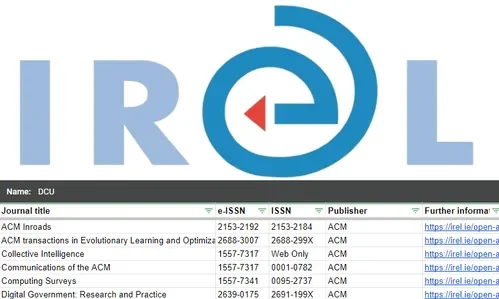
Articles accepted on or after 01/01/26 for journals listed in the IReL spreadsheet are eligible for coverage from the 2026 agreements.
- Gold OA refers to publishers making content open without a subscription or embargo period
- Typically this is funded via an Article Processing Charge or APC, a one-off payment for publishing services
- DCU members may avail of Publisher Agreements negotiated by DCU Library/IReL to fund APCs
- These agreements cover over 11,000 journals. See the full list at http://bit.ly/irelOAjournals or by publisher in the table below
Please note:
- The corresponding author must be a DCU member, usually at the point when the article is accepted for publication
- An agreement with a publisher may not include all of their journals
- APC allocations are not unlimited and may expire within a calendar year
Click on a publisher name below to see full terms of each agreement.
Publishers shaded in yellow/orange below are those we have a projection for when their allocation is likely to expire for 2026. These are subject to change and are updated as and when we receive further notifications from IReL.
| ACM Open | Elsevier (Cell Press) |
Rockefeller University Press |
| AIP | Elsevier (ScienceDirect) Expected expiry: November |
RIA |
| Emerald | Royal Society | |
| American Physical Society | IEEE Expected expiry: October |
Royal Society of Chemistry |
| ASME | Institute of Physics | Sage |
| Annual Reviews | John Benjamins | SCOAP3 |
| BMJ | Microbiology Society | Springer Nature Expected expiry: August |
| Cambridge UP | Optica | Taylor & Francis Expected expiry: July |
| De Gruyter Brill | Oxford UP Expected expiry: October |
The Company of Biologists |
| Electrochemical Society | PLOS | Wiley Expected expiry: November |
For further guidance on APCs contact Liam O'Dwyer, Open Research Librarian at: liam.odwyer@dcu.ie.
Policies and Strategies
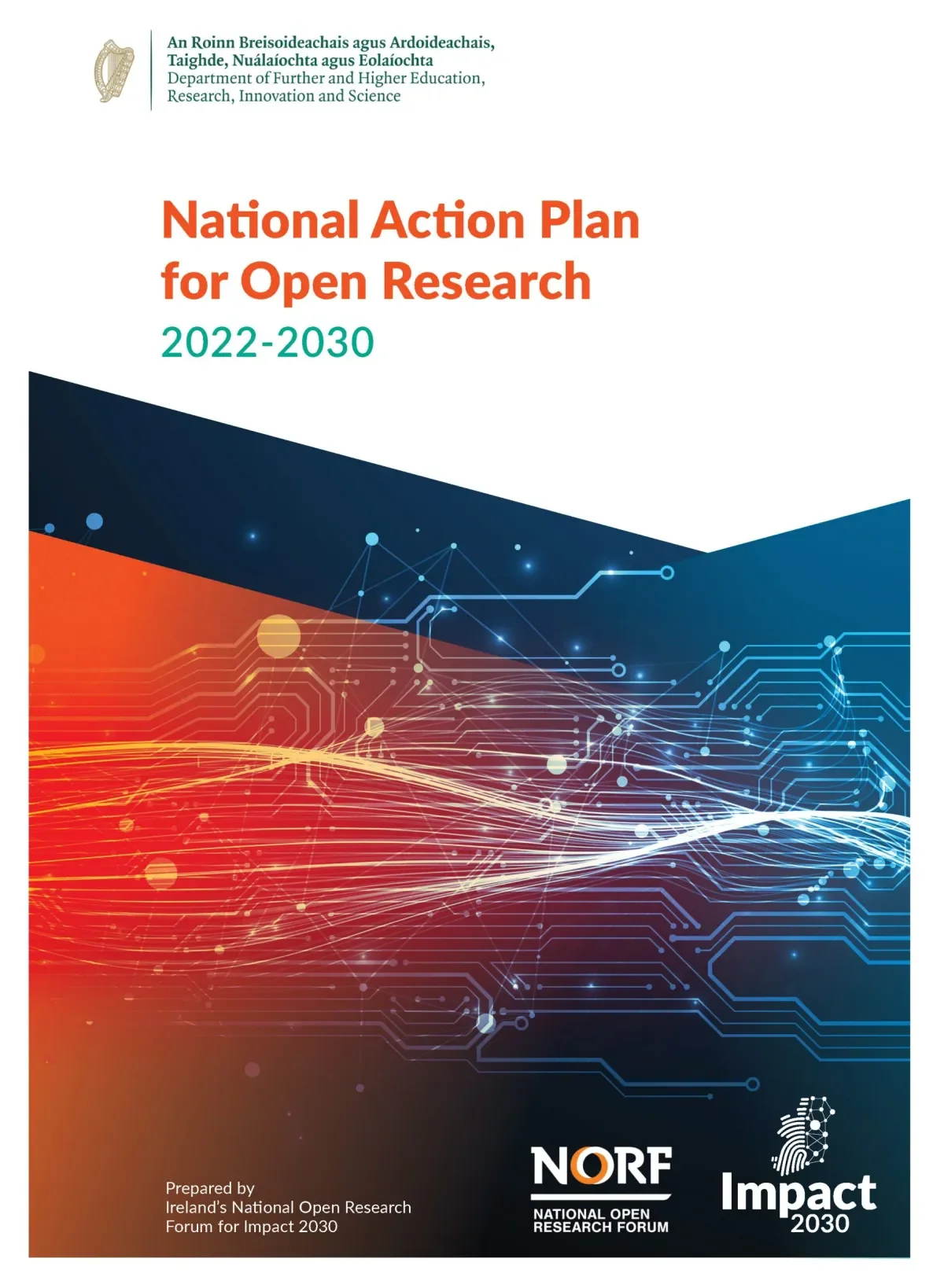
Alongside the benefits of open access, it is also increasingly a requirement of funded research:
- Taighde Éireann / Research Ireland
- Health Research Board (HRB)
- Environmental Protection Agency (EPA)
- EU Horizon
- European Research Council
In a national and local context, the NORF Action Plan commits to 100% OA by 2030, while DCU's Strategy 2023-28 commits to 75% of its published articles as OA in 5 years.
Open Access Publishing in DCU
DCU is actively involved in a number of open publishing initiatives, including DCU Press, which launched its first book in January 2024.