

Open Research
DCU Open Research
Share your work with the world

Open Research aims to increase openness, transparency and reproducibility across all parts of the research lifecycle. It is considered beneficial to all involved in the research process - funders, researchers, policymakers, and to society as a whole.
See the University's Open Research Statement below. DCU's Research Strategy also includes as an objective the aim to "support, encourage, incentivise and provide training for broad open research practices".
Open research activities in DCU are supported by the Library and the Research Office.
Quick Links
More on...




Quick Guides
How to submit to Doras
Open Research 101
ORCID Explained
Glossary
The AAM is the version of your work which:
- has been accepted for publication
- has been peer-reviewed
- has not yet gone through typesetting and layout by the publisher
This is typically the version that can be made Open Access through 'Green' OA, depositing it in an open access repository such as DORAS.
For more information see the Open Access page.
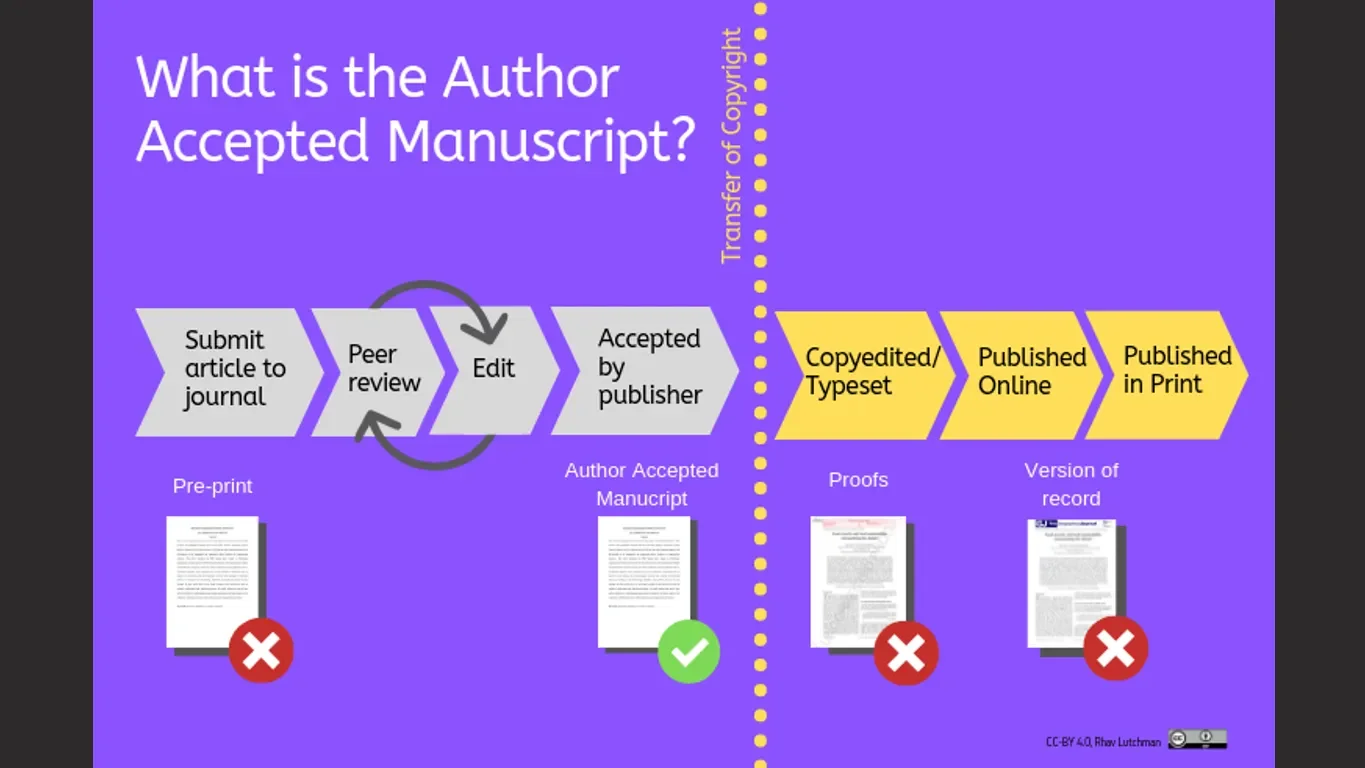
Article versions in publishing process
Altmetrics are alternative ways of recording and measuring the use and impact of scholarship beyond citations in scholarly literature. This is primarily by measuring online interactions with research outputs. They include, measure and analyse social media, document downloads and other uses of research literature. Supporters of altmetrics believe that including these kinds of interactions alongside tradition metrics such as citation counts will give a more complete picture of how research and scholarship is used.
A one-off charge levied by publishers to publish an article as 'Gold' open access, so that it is made freely accessible upon publication on the publisher or journal website. This model moves the charge away from the end user, going from ‘paying to read’ to ‘paying to publish'.
Bronze open access refers to when publishers make a selection of papers free to read their website. This typically omits a licence for reuse or a commitment to its long term open accessibility.
Creative Commons licences are a free and standardised way to grant copyright permissions for creative and academic works, ensure proper attribution; and allow others to copy, distribute, and make use of those works.
In the context of Open Access publishing, authors typically retain copyright of their Author Accepted Manuscript and may apply a CC licence to allow others to freely access and reuse their work without the need to obtain permission.
Citizen science refers to projects and practices that actively involve the general public in the scientific endeavour, with the goal of democratizing science. Citizen scientists can be involved in all stages of research, acting as collaborators, contributors or project leaders.
More information on Citizen Science in DCU.
The corresponding author of a paper is the author designated to receive any post-publication communication from the publisher. Eligibility for Gold OA publisher agreements is almost always based on the corresponding author’s affiliation.
Diamond open access is full open access without article or book processing charges. There are a number of funding models which may support such publications, including consortial or institutional support.
DOAJ is a searchable database of around 20,000 international open access journals.
A DOI is a unique text string that is used to identify digital objects such as journal articles, data sets or open source software releases. A DOI is one type of Persistent Identifier (PID).
The San Francisco Declaration of Research Assessment (DORA) is a global initiative that aims to reduce dependence on journal-based metrics such as journal impact measures and citations towards a culture where importance is placed on the intrinsic value of research.
The DORA declaration was published in 2012 and targets research funders, publishers, research institutes and researchers. The declaration has already been signed by more than 1,200 organisations and almost 14,000 researchers around the world.
Doras (DCU Online Research Access Service) is DCU's institutional repository, a freely accessible collection of scholarly publications from DCU's academic community. It is operated on behalf of the University by the Library.
All hosted material is fully compliant with publisher's copyright, and is fully indexable by the world's leading search engines, ensuring maximal visibility for the collection.
We strongly encourage all staff and researchers to make their research publications available on DORAS.
Some Doras FAQs...
- What kinds of items can be uploaded to Doras?
Doras accepts: journal articles, books and book chapters, research theses, conference items, monographs, working papers -
Will I break copyright if I store my work in Doras?
No. Full copyright checking means that a member of the Doras team will check publisher copyright policies to make sure that uploaded material is fully compliant with these policies before these items are promoted to the public archive. Publisher copyright policies will always be respected -
Who can submit items to Doras?
All DCU affiliated staff and postgraduate research students. You can upload material on behalf of somebody else, but they must be DCU affiliated. Papers co-authored with colleagues from another institution, these items are also suitable. -
I need help! Who do I contact?
For any questions, queries, support please contact doras@dcu.ie.
These principles describe making scholarly materials findable, accessible, interoperable and reusable (FAIR). Findable and accessible are terms concerned with where materials are stored (for example, in data repositories), while the interoperable and reusable terms focus on the importance of data formats and how such formats might change in the future
Gold OA is the model of making a published work free to access via the publisher website upon publication. This typically requires articles processing charges (APCs), usually applied at the point an article is accepted for publication. There are two kinds of journals which provide APC-based Gold OA:
- 'Fully gold' journals, in which all their articles are published in this way.
- 'Hybrid' journals contain both traditional (paywalled) and Gold OA articles.
- Green OA refers to an author self-archiving their article in an institutional repository, preprint server or other venue.
- These articles may also be submitted to a publisher and multiple versions may exist
- Often the version of record is published in the journal of your choice, while the Author Accepted Manuscript (AAM) is deposited in a repository such as Doras and made openly available, sometimes after an embargo period set by the publisher.
A hybrid journal is one which contains both open access and subscription-only articles. Typically the OA articles follow the Gold OA model with an APC applied during the publishing process.
A numerical measure of a journal indicating the average number of citations to articles published over the previous two years in a given journal title. It is frequently used as a proxy for a journal's relative importance. Its use as a proxy for the impact of individual articles is problematic. Responsible metrics guards against such pitfalls by taking a broader view of research impact and quality.
Ireland’s National Open Research Forum (NORF) was established in 2017 to drive the national agenda for Open Research.
NORF provides a space for communication, consultation and cooperation among key stakeholders in the research system regarding strategic issues and overarching policies and procedures on Open Research.
NORF developed Ireland’s National Framework on the Transition to an Open Research Environment (2019) and National Action Plan for Open Research (2022). Since 2022, NORF has adminstered an Open Research Fund to support the implementation of the National Action Plan.
Our Open Research Taskforce was formed with the primary aim of implementing the National Action Plan in DCU.
Open access (OA) refers to making scholarly research freely available online for anyone to read. Typically, open access also allows readers to redistribute, re-use and adapt content in new works.
Open data is research data free for anyone to access or reuse. This can support reproducibility and transparency of research and may include raw data, processed data, code, or media files (e.g., images, maps, video, audio, text).
Open peer review involves the disclosure of peer review data which can include the reviewer names and comments, editor information, author response(s) to reviewers, and/or decision letter(s). The level of information that is available depends on the peer review model, author opt-in, and reviewer opt-in.
ORCID stands for Open Researcher and Contributor ID. It provides a persistent digital identifier (an ORCID iD) that you own and control, and that distinguishes you from every other researcher. You can connect your iD with your professional information — affiliations, grants, publications, peer review, and more.
ORCiD also describes the organisation, a global, not-for-profit organisation sustained by fees from our member organizations. DCU are a member of the Irish ORCiD consortium.
Plan S, an initiative of cOAlition S, was launched in September 2018 with the goal of achieving full and immediate open access to publications.
It comprises a group of research funders that has committed to implementing Plan S, and aims to accelerate the transition to a scholarly publishing system characterised by immediate and free online access to scholarly publications.
In Ireland Plan S is supported by the Health Research Board, the Irish Research Council and Science Foundation Ireland.
Research data management (RDM) refers to the handling of research data (collection, organisation, storage, and documentation). Good data management helps ensure that researchers manage and share their data according to FAIR principles (findable, accessible, interoperable, and re-useable).
Research and funding organisations increasingly require researchers to develop a Data Management Plan (DMP). This is a written document that describes the data you expect to acquire or generate during the course of a research project, how you will manage, describe, analyse, and store those data throughout the research project, and what mechanisms you will use at the end of your project to share and preserve your data.
See below a guide for DCU researchers seeking to develop a Research Data Management Plan which outlines key considerations, good practices and useful resources.
The responsible use of research metrics forms an important part of the global move towards Open Research, featuring also in recommendations made in the National Framework on the Transition to an Open Research Environment (NORF, 2019).
DCU has published a Statement on the Responsible Use of Research Metrics. It sets out guiding principles for those using research metrics for assessment, to ensure a nuanced and balanced approach is taken.
More information on our Responsible Metrics page.
Self-archiving refers to authors depositing a copy of a document online to make it freely available to others to read. The term usually refers to documents such as peer-reviewed research journal and conference articles, theses or book chapters, in an institutional or disciplinary repository for the purpose of maximizing accessibility, usage and impact.
This describes Green Open Access. Find more information on our Open Access page.
DCU (via the IReL consortium) have entered into Open Access Transformative Agreements with a large number of publishers to facilitate DCU authors to publish Open Access (Gold) without paying an Article Processing Charge (APC).